
Many organisations assume that designing a wireless network for a warehouse is no different to deploying WiFi in an office.
In reality, the two environments have completely different wireless requirements.
An office network is designed primarily to support laptops, smartphones and video conferencing. A warehouse WiFi network, on the other hand, must provide uninterrupted connectivity for barcode scanners, handheld terminals, voice picking systems, Warehouse Management Systems (WMS), mobile printers, IoT devices and increasingly warehouse automation.
When office WiFi experiences a temporary slowdown, productivity may suffer. When warehouse WiFi fails, operations can stop completely.
Whether you require warehouse Wi-Fi or office WiFi, the challenge remains the same: designing a wireless network that delivers reliable coverage, seamless roaming and consistent performance across a demanding operational environment.
In this blog, we’ll explain why warehouse wireless networks require a completely different approach to office deployments and why a professional WiFi survey is often the first step towards a reliable warehouse network.
Warehouse environments behave very differently
Office buildings are generally predictable environments.
Most have:
🔹 Standard ceiling heights
🔹 Plasterboard partitions
🔹 Carpeted floors
🔹 Fixed workstations
🔹 Relatively static layouts
These characteristics make wireless signal propagation reasonably straightforward.
Warehouses present a completely different RF environment.
High ceilings, steel racking, changing stock levels, forklifts and industrial equipment all influence how wireless signals travel throughout the building.
Common warehouse challenges include:
🔹 Signal reflections from steel racking
🔹 RF shadowing behind stored goods
🔹 Variable attenuation as stock levels change
🔹 Interference from industrial equipment
🔹 Long aisle layouts
🔹 Large open operational spaces
A wireless design that performs perfectly in an office may deliver unreliable coverage throughout a warehouse.
This is why warehouse WiFi should always begin with a professional WiFi site survey rather than simply installing additional access points.

Mobility is critical in a warehouse
One of the biggest differences between office and warehouse wireless networks is user mobility.
Office workers generally remain in one location for long periods.
Warehouse users rarely do.
Employees, forklifts and mobile equipment constantly move throughout the facility while relying on uninterrupted connectivity.
Devices commonly roaming throughout warehouses include:
🔹 Barcode scanners
🔹 Vehicle-mounted terminals
🔹 Rugged tablets
🔹 Voice picking devices
🔹 Mobile printers
🔹 Handheld computers
Every time these devices move between access points, they perform a wireless roaming event.
If roaming isn’t properly designed, users experience:
🔹 Scanner disconnects
🔹 Buffered transactions
🔹 Dropped voice sessions
🔹 Delayed inventory updates
🔹 Interrupted warehouse workflows
A professional WiFi network survey analyses roaming behaviour throughout the warehouse, helping engineers optimise access point placement, overlap and configuration for seamless mobility.

Warehouse devices have different wireless requirements
Office environments mainly support laptops, smartphones and tablets.
Warehouse operations rely on business-critical devices that often have very different wireless capabilities.
Examples include:
🔹 Zebra barcode scanners
🔹 Honeywell handheld terminals
🔹 Datalogic mobile computers
🔹 Vehicle-mounted terminals
🔹 RFID readers
🔹 Industrial IoT sensors
Many of these devices have smaller antennas and lower transmit power than modern laptops.
As a result, they are less tolerant of poor coverage and interference.
Warehouse WiFi should always be designed around the operational devices—not around smartphones or office laptops.

Warehouse WiFi must support business-critical applications
Office WiFi typically supports:
🔹 Microsoft Teams
🔹 Email
🔹 Internet browsing
🔹 File sharing
🔹 Video conferencing
Warehouse WiFi often supports applications that directly affect operational productivity, including:
🔹 Warehouse Management Systems (WMS)
🔹 Barcode scanning
🔹 Stock control
🔹 Goods-in and dispatch
🔹 Voice picking
🔹 Real-time inventory updates
🔹 Warehouse automation
🔹 RFID tracking
When wireless connectivity becomes unreliable, picking slows, inventory updates fail and dispatch operations can quickly fall behind schedule.
Reliable warehouse WiFi isn’t simply an IT requirement, it’s an operational necessity.

Access point placement is far more complex
Installing access points in an office is usually straightforward.
Ceilings are relatively low, line-of-sight is good and users are positioned beneath the access points.
Warehouses introduce several additional design challenges.
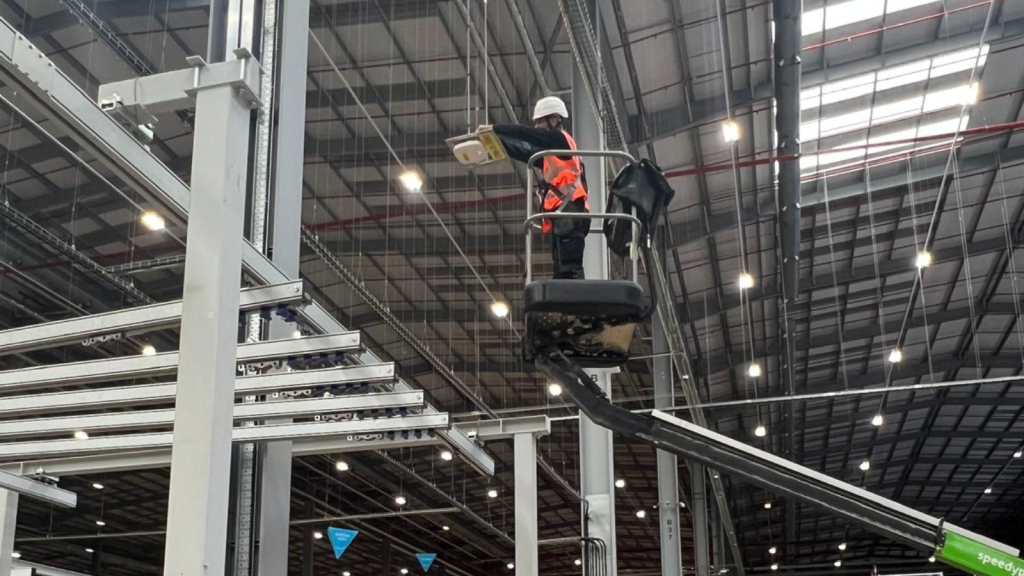
Access points may need to be mounted:
🔹 More than 12 metres above floor level
🔹 Between warehouse aisles
🔹 On steel structures
🔹 Around moving machinery
🔹 Above loading bays
Incorrect positioning can result in:
🔹 Coverage holes
🔹 Excessive interference
🔹 Poor roaming
🔹 Weak aisle coverage
🔹 Reduced throughput
Professional warehouse WiFi design considers antenna selection, mounting height, aisle orientation and RF behaviour rather than simply increasing the number of access points.
Capacity matters just as much as coverage
Many warehouse networks appear to have excellent signal strength.
Unfortunately, good signal doesn’t always mean good performance.
A warehouse may have sufficient coverage while still suffering from:
🔹 Channel congestion
🔹 High client density
🔹 Airtime contention
🔹 Poor roaming
🔹 Capacity bottlenecks
A professional WiFi survey measures far more than signal strength.
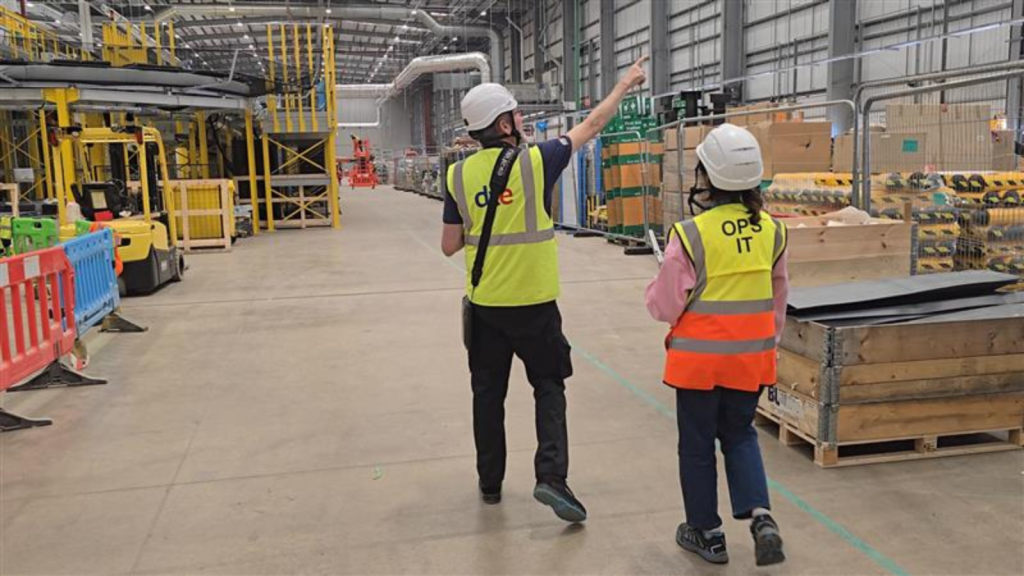
It also analyses capacity, channel utilisation, interference, roaming performance and overall wireless health to ensure the network supports operational demand.
Why warehouse WiFi surveys are essential
Unlike office environments, warehouse RF conditions continually change.
Stock moves.
Racking changes.
Equipment is introduced.
Operations expand.
Without accurate RF data, it’s impossible to know whether the wireless infrastructure continues meeting operational requirements.
A professional warehouse WiFi survey provides detailed heatmaps and performance analysis, helping identify:
🔹 Coverage gaps
🔹 RF interference
🔹 Poor roaming
🔹 Incorrect access point placement
🔹 Capacity limitations
🔹 Dead zones
🔹 Channel congestion
This allows businesses to make informed decisions rather than relying on assumptions.

Warehouse WiFi is an operational asset
As warehouses become increasingly automated, wireless connectivity is becoming just as important as power or network cabling.
Supporting technologies such as barcode scanners, Warehouse Management Systems, RFID, autonomous mobile robots (AMRs) and IoT sensors all depend on reliable wireless connectivity.
The question is no longer whether your warehouse has WiFi coverage.
The real question is whether that wireless network has been specifically designed for the operational demands of a warehouse or simply adapted from an office deployment.

Improve warehouse WiFi performance with DTE
At DTE, we design, survey and optimise warehouse wireless networks that support modern logistics operations.
Our engineers use professional WiFi surveys, predictive wireless modelling and detailed RF analysis to help businesses eliminate dead zones, improve roaming performance and build wireless networks that support both current operations and future growth.
Whether you’re upgrading an existing warehouse, deploying a new facility or investigating ongoing wireless issues, we can help design a warehouse WiFi solution that delivers reliable coverage where it matters most.
Speak to one of our warehouse WiFi specialists today to discuss your wireless survey or warehouse network design requirements.
Speak to a Specialist
Provide your details below, email [email protected] or call +44 (0) 845 658 8810.