
If you’re investigating slow WiFi, planning a new wireless deployment or looking to improve network performance, you’ve probably come across two common terms:
🔹 Active Wi-Fi Survey
🔹 Passive WiFi Survey
At first glance, they sound similar.
In reality, they measure very different aspects of your wireless network.
Choosing the right survey depends entirely on what you’re trying to achieve.
Understanding the difference between active and passive surveys helps ensure you collect the right information before making decisions about your wireless infrastructure.
In this blog, we’ll explain how each survey works, when each should be used and why many organisations benefit from using both together.
What is a passive WiFi survey?
A passive WiFi survey measures the wireless environment without connecting to the network.
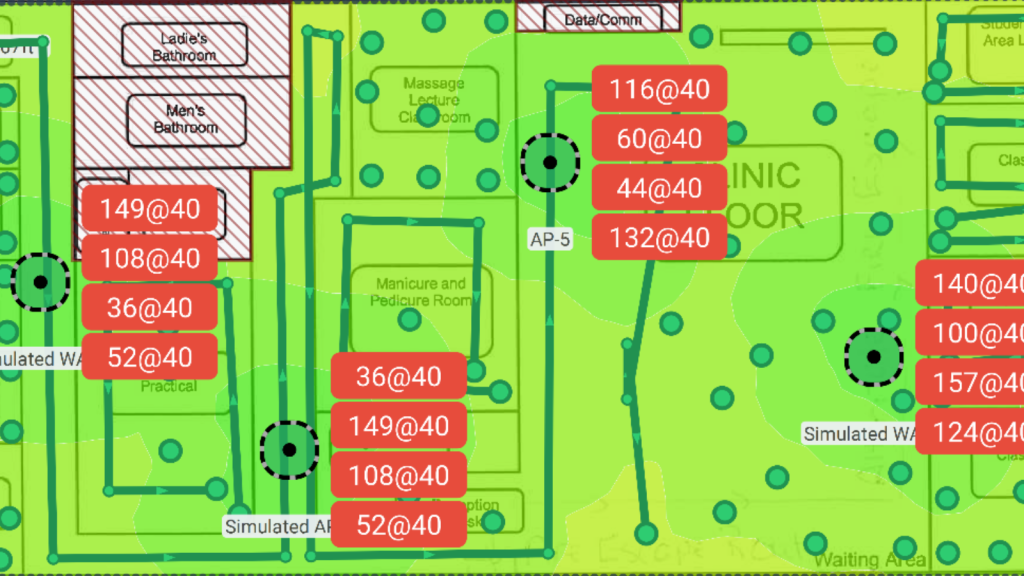
Using professional survey software such as Ekahau AI Pro, engineers walk throughout the building collecting wireless information from every access point they can detect.
Because the survey tool is listening rather than transmitting traffic, it provides a detailed picture of the radio frequency (RF) environment.
A passive survey typically measures:
🔹 Signal strength (RSSI)
🔹 Signal-to-noise ratio (SNR)
🔹 Wireless coverage
🔹 Channel utilisation
🔹 Co-channel interference (CCI)
🔹 Adjacent channel interference (ACI)
🔹 Access point overlap
🔹 RF noise
This makes passive surveys ideal for understanding how wireless signals behave throughout a building.
When should you use a passive survey?
Passive surveys are commonly used when organisations need to:
🔹 Understand wireless coverage
🔹 Identify dead zones
🔹 Detect RF interference
🔹 Validate access point placement
🔹 Review channel planning
🔹 Troubleshoot poor wireless coverage
Because they collect information about the entire RF environment, passive surveys are often the first step in diagnosing wireless issues.
If your business is experiencing coverage problems or unreliable roaming, consider a WiFi survey to identify these issues before they begin affecting users.

What is an active WiFi survey?
An active WiFi survey goes a step further.
Instead of simply listening to the wireless environment, the survey device actively connects to your WiFi network and behaves like a normal client device.
This allows engineers to measure how the network performs under real operating conditions.
An active survey can assess:
🔹 Connection quality
🔹 Throughput
🔹 Latency
🔹 Jitter
🔹 Packet loss
🔹 Roaming performance
🔹 Upload and download performance
🔹 Client experience
Rather than showing what wireless coverage looks like, an active survey demonstrates how well applications actually perform across the network.
When should you use an active survey?
Active surveys are particularly valuable when businesses experience issues that only become apparent during normal operation.
Typical examples include:
🔹 Microsoft Teams calls dropping
🔹 VoIP quality issues
🔹 Slow cloud applications
🔹 Barcode scanners disconnecting
🔹 Poor wireless roaming
🔹 Intermittent application performance
Because the engineer connects to the network while moving around the site, active surveys provide an accurate picture of the user experience rather than simply measuring RF conditions.

The difference at a glance
| Passive WiFi Survey | Active WiFi Survey |
|---|---|
|
Listens to the wireless environment |
Connects to the wireless network |
|
Measures RF coverage |
Measures user experience |
|
Identifies interference |
Measures throughput |
|
Detects coverage gaps |
Measures latency |
|
Reviews channel planning |
Tests roaming performance |
|
Best for wireless design |
Best for troubleshooting performance |
Neither survey is “better”.
They simply answer different questions.
When is a Passive Survey most useful?
Warehouse wireless networks often benefit from both survey types.
A passive survey helps engineers understand:
🔹 Coverage between warehouse aisles
🔹 RF reflections from steel racking
🔹 Access point overlap
🔹 Interference
🔹 Coverage consistency
An active survey then validates how operational devices perform while moving throughout the warehouse.
This is particularly important for:
🔹 Barcode scanners
🔹 Vehicle-mounted terminals
🔹 Voice-picking systems
🔹 Warehouse Management Systems (WMS)
🔹 Rugged handheld devices
If your warehouse experiences scanner disconnects or poor roaming, you may want to consider taking a closer look at your existing wireless network and evaluating a new warehouse Wi-Fi solution.

Can active and passive surveys be used together?
Absolutely.
In fact, this is often the best approach.
A passive survey provides an accurate understanding of the RF environment, while an active survey validates how the network performs for real users.
Together they provide a much more complete assessment than either survey alone.
Many post-installation surveys combine both methods to validate wireless design, identify optimisation opportunities and confirm the network performs as expected.
Which survey should you choose?
As a simple guide:
Choose a Passive WiFi Survey if you want to:
🔹 Review wireless coverage
🔹 Identify dead zones
🔹 Detect interference
🔹 Validate access point placement
🔹 Assess wireless design
Choose an Active WiFi Survey if you want to:
🔹 Troubleshoot performance problems
🔹 Test roaming
🔹 Measure latency
🔹 Assess throughput
🔹 Validate application performance
If you’re unsure, a professional wireless engineer can recommend the most appropriate survey based on your building, users and operational requirements.

Improve wireless performance with DTE
Whether you’re planning a new deployment or investigating ongoing wireless issues, understanding how your network performs is the first step towards improving reliability.
At DTE, we deliver professional WiFi surveys using industry-leading wireless survey tools to help businesses identify coverage gaps, roaming issues, RF interference and performance bottlenecks.
From offices and healthcare environments to warehouses and manufacturing facilities, we help organisations build wireless networks that support both today’s operations and tomorrow’s growth.
Speak to a Specialist
Provide your details below, email [email protected] or call +44 (0) 845 658 8810.