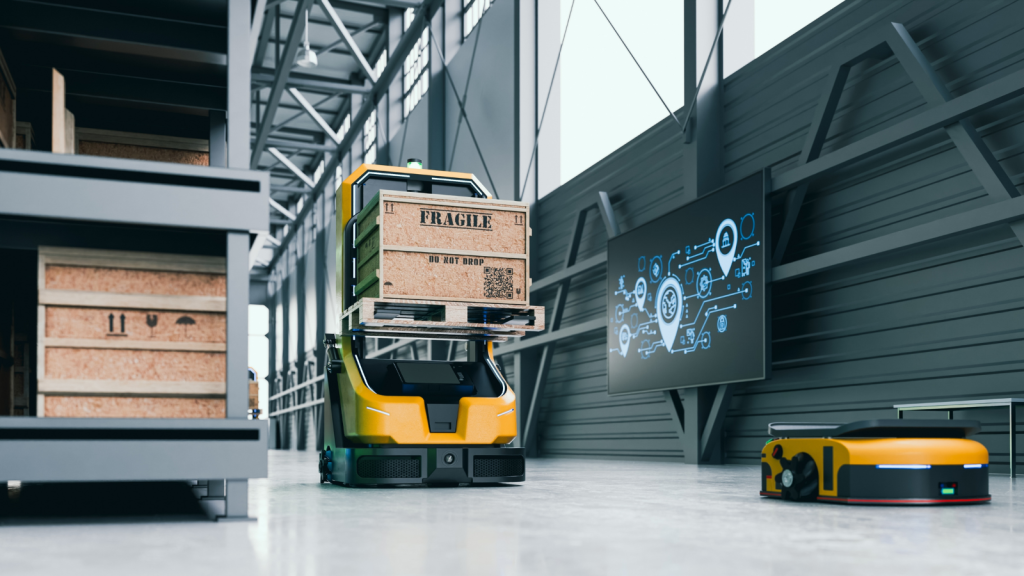
Autonomous Mobile Robots (AMRs) are becoming increasingly common in warehouses and distribution centres.
Rising labour costs, pressure to increase productivity and the need for more flexible operations are encouraging adoption. However, cost, integration and infrastructure concerns are still delaying some projects.
So, what is driving AMR adoption and what is holding warehouse operators back?
What is encouraging AMR adoption?
Labour Challenges
Recruitment, retention and rising labour costs are encouraging warehouses to automate repetitive material movement.
AMRs can transport goods, totes and pallets between warehouse zones, allowing employees to focus on tasks where people provide greater value.
Increased Productivity
Warehouses are expected to process more orders within tighter timescales.
By reducing unnecessary walking and manual transportation, AMRs can help improve productivity and throughput without continually increasing headcount.
Greater Flexibility
Unlike fixed automation such as conveyors, AMRs can provide greater flexibility as warehouse requirements change.
Routes and workflows can be adapted, while fleets can be expanded as demand increases. This makes AMRs particularly attractive for warehouses experiencing seasonal peaks, changing layouts or growing order volumes.
Improved Safety
Automating repetitive transportation tasks can reduce the amount of manual movement around a warehouse.
AMRs are also designed to navigate environments shared with employees and equipment, although routes, pedestrian areas and warehouse traffic still require careful planning.
What is delaying AMR adoption?
Cost & ROI
Warehouse operators need a clear business case before investing.
The total project can include AMR hardware, software, integration, network infrastructure, maintenance and training.
Businesses therefore need to understand whether improvements in productivity, labour utilisation and scalability justify the investment.
Integration Complexity
AMRs rarely operate independently.
They may need to communicate with warehouse management systems, conveyors, doors, lifts and other automated equipment.
Successful projects can therefore require collaboration between operations, IT, networking, facilities teams, automation specialists and AMR vendors.
Existing Infrastructure
Infrastructure is another potential barrier.
AMRs can depend heavily on reliable wireless connectivity as they move throughout a warehouse. However, an existing warehouse Wi-Fi network wasn’t necessarily designed to support mobile automation.
What is delaying AMR adoption?
An employee using a handheld scanner may tolerate a brief connectivity issue. An AMR performing an automated workflow may be more dependent on consistent connectivity.
Warehouses can also be challenging RF environments due to high racking, metal, machinery and constantly changing stock.
A professional WiFi survey can identify coverage gaps, interference and roaming issues before robots are deployed.
DTE’s Wi-Fi for Automation solutions help businesses assess and optimise wireless networks for AMRs, AGVs and other automated technologies.
Preparing warehouses for AMR adoption
AMRs can help warehouse operators improve productivity, address labour challenges and create more flexible operations.
But successful adoption requires more than choosing the right robots.
Businesses also need to consider integration, processes, safety, infrastructure and scalability from the beginning of the project.
For AMRs that depend on wireless connectivity, assessing the network early can help identify potential problems before they affect deployment.
Planning an AMR deployment or expanding an existing fleet? Speak to DTE about assessing whether your wireless infrastructure is ready for automation.