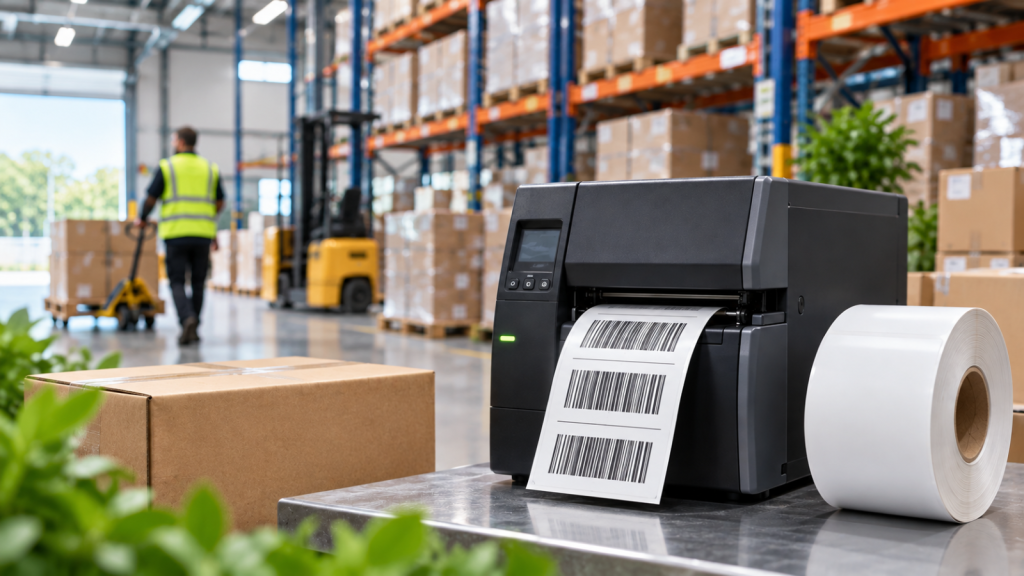
Sustainability within warehouses is often associated with areas such as energy consumption, lighting, transport and automation.
However, labelling and printing can also play an important role.
From the materials used to produce labels to errors that result in goods being mislabelled or transported incorrectly, relatively small changes to warehouse printing processes can help reduce waste while improving operational efficiency.
So, how can warehouses make their labelling operations more sustainable?
Reduce labelling errors
Accurate labelling helps ensure products, pallets and shipments move through the warehouse and supply chain correctly.
When labels are incorrect, damaged or difficult to scan, the impact can extend beyond simply printing another label.
Errors can contribute to:
🔹 Mislabelled products
🔹 Incorrect picking and shipping
🔹 Unnecessary movement of goods
🔹 Additional transport
🔹 Reprinting and wasted consumables
🔹 Extra warehouse processing
Improving the reliability and accuracy of warehouse labelling can therefore support both operational efficiency and sustainability.
Review label and consumable usage
Warehouse operators should also consider the materials being consumed as part of their labelling processes.
This includes the label itself, backing material, ribbons and other consumables.
Assessing where materials are being wasted and whether alternative technologies are available can help organisations reduce the environmental impact associated with high-volume warehouse printing.
Consider linerless label printing
Linerless printing removes the traditional backing liner found on many labels.
For suitable applications, this can significantly reduce the amount of material that needs to be handled and disposed of.
Simon Brennan, Senior Business Manager at Brother, explains that moving some customers to linerless solutions can deliver around a 40% saving on recyclable material.
Linerless technology can therefore provide an opportunity to reduce waste while maintaining the labelling required for warehouse and logistics operations.
Explore alternative technologies such as RFID
Sustainability improvements do not necessarily have to come solely from changing label materials.
Technologies such as RFID can also help warehouses improve the way products and inventory are identified and tracked.
RFID can support faster inventory checking and reduce the amount of manual activity required to locate and verify stock.
By improving inventory visibility and reducing the time spent checking products, warehouses may also reduce unnecessary movement and associated energy consumption.
Look at the wider warehouse process
Sustainable labelling should be considered as part of the wider warehouse operation rather than as an isolated printing exercise.
Businesses should look at how labels interact with:
🔹 Warehouse management systems
🔹 Barcode scanners
🔹 Mobile devices
🔹 Inventory processes
🔹 Picking and packing
🔹 Shipping and dispatch
Improving the complete process can help reduce errors, unnecessary movement and avoidable resource consumption.
Making warehouse labelling more sustainable
For some operations, the biggest opportunity may come from reducing printing errors and wasted consumables. For others, technologies such as linerless printing or RFID could help reduce material usage and make inventory processes more efficient.
Reviewing the complete labelling workflow can help warehouse operators identify where improvements can deliver both environmental and operational benefits.
DTE supplies and supports industrial label printers from leading manufacturers, helping organisations identify printing technology suited to their warehouse requirements.